Magnolia Oil & Gas (MGY)·Q4 2025 Earnings Summary
Magnolia Oil & Gas Beats on All Metrics, Sets Production Record as Shares Slip
February 6, 2026 · by Fintool AI Agent
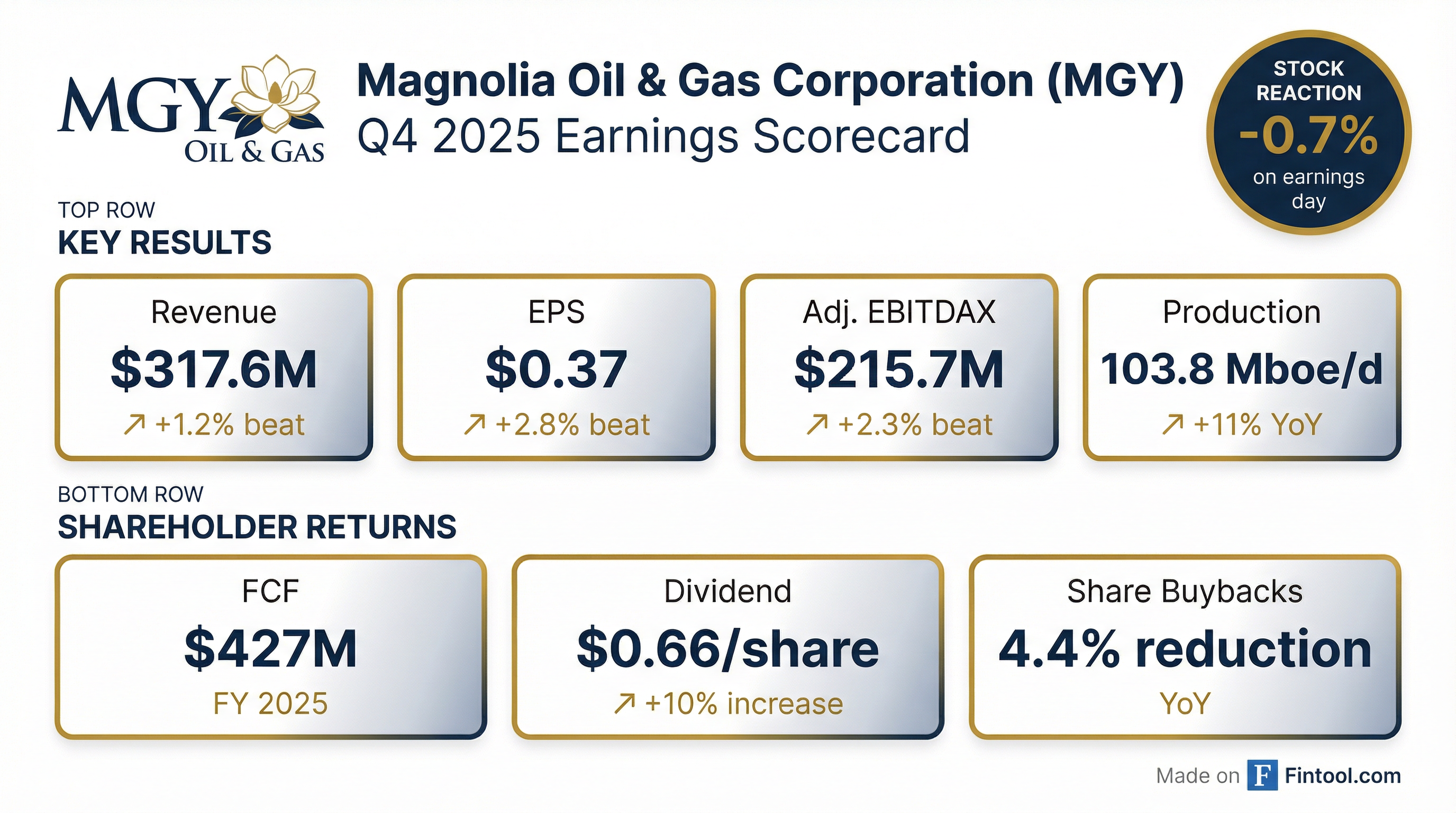
Magnolia Oil & Gas delivered a triple beat in Q4 2025, topping estimates on revenue, EPS, and EBITDA while setting new production records. The Eagle Ford-focused operator reported revenue of $317.6M (+1.2% vs. consensus), EPS of $0.37 (+2.8% beat), and Adjusted EBITDAX of $215.7M (+2.3% beat). Despite the strong results, shares slipped 0.7% on the day, suggesting the market had already priced in the outperformance.
Did Magnolia Beat Earnings?
Magnolia delivered beats across all key financial metrics in Q4 2025:
*Values retrieved from S&P Global.
The company achieved record quarterly production of 103.8 Mboe/d, up 11% year-over-year and exceeding earlier guidance. Oil production hit 40.7 Mbbl/d, also a quarterly record.
For full-year 2025, Magnolia generated:
- Total Revenue: $1,312M (flat YoY)
- Adjusted EBITDAX: $906M (-5% YoY)
- Free Cash Flow: $427M
- Return on Capital Employed: 18%
 Ask Fintool AI Agent
What Did Management Guide?
Magnolia provided 2026 guidance that reflects continued disciplined capital allocation:
CEO Chris Stavros emphasized the company's differentiated approach: "Magnolia's primary goals and objectives are to be the most efficient operator of our best-in-class oil and gas assets, to generate the highest returns on those assets, and while employing the least amount of capital for drilling and completing wells, no matter the product prices."
The Street is modeling FY 2026 revenue of $1.28B* and EPS of $1.55*, implying modest top-line compression but stable earnings power.
*Values retrieved from S&P Global.
How Did the Stock React?
Despite the triple beat, MGY shares closed down 0.7% at $26.20 on earnings day. The muted reaction suggests:
- Results were priced in: Shares rallied ~13% in the prior month (from ~$23 to ~$26)
- Oil price headwinds: WTI averaged $59.13/bbl in Q4 vs. $70.28 in Q4 2024
- Conservative 2026 outlook: ~5% production growth is below the 11% achieved in 2025
The current price of $26.20 compares to an analyst target of $26.94*, offering limited upside (~3%).
*Values retrieved from S&P Global.
What Changed From Last Quarter?
Key deltas from Q3 2025:
The revenue decline despite higher production reflects weaker commodity realizations:
- Oil: $57.54/bbl vs. $63.18/bbl for full year
- Natural gas: $2.92/Mcf vs. $2.76/Mcf for full year
Production by Asset (Q4 2025):
Giddings production grew 16% YoY and now represents 80% of total company volumes.
Development Approach for 2026:
- Pad size: 3-4 wells per pad on average (some 2-well and 5-well pads)
- Lateral lengths: 8,000-8,500 ft average; up to 12,000-13,000 ft when acreage allows
- Giddings working interest: Improved from mid-70s% to low-80s% through bolt-on acquisitions
- Cycle times: ~28 gross wells per rig per year
Q1 2026 LOE Note: Expect seasonally higher LOE due to winter weather repairs and annual field bonus payments.
Capital Allocation: The Magnolia Flywheel
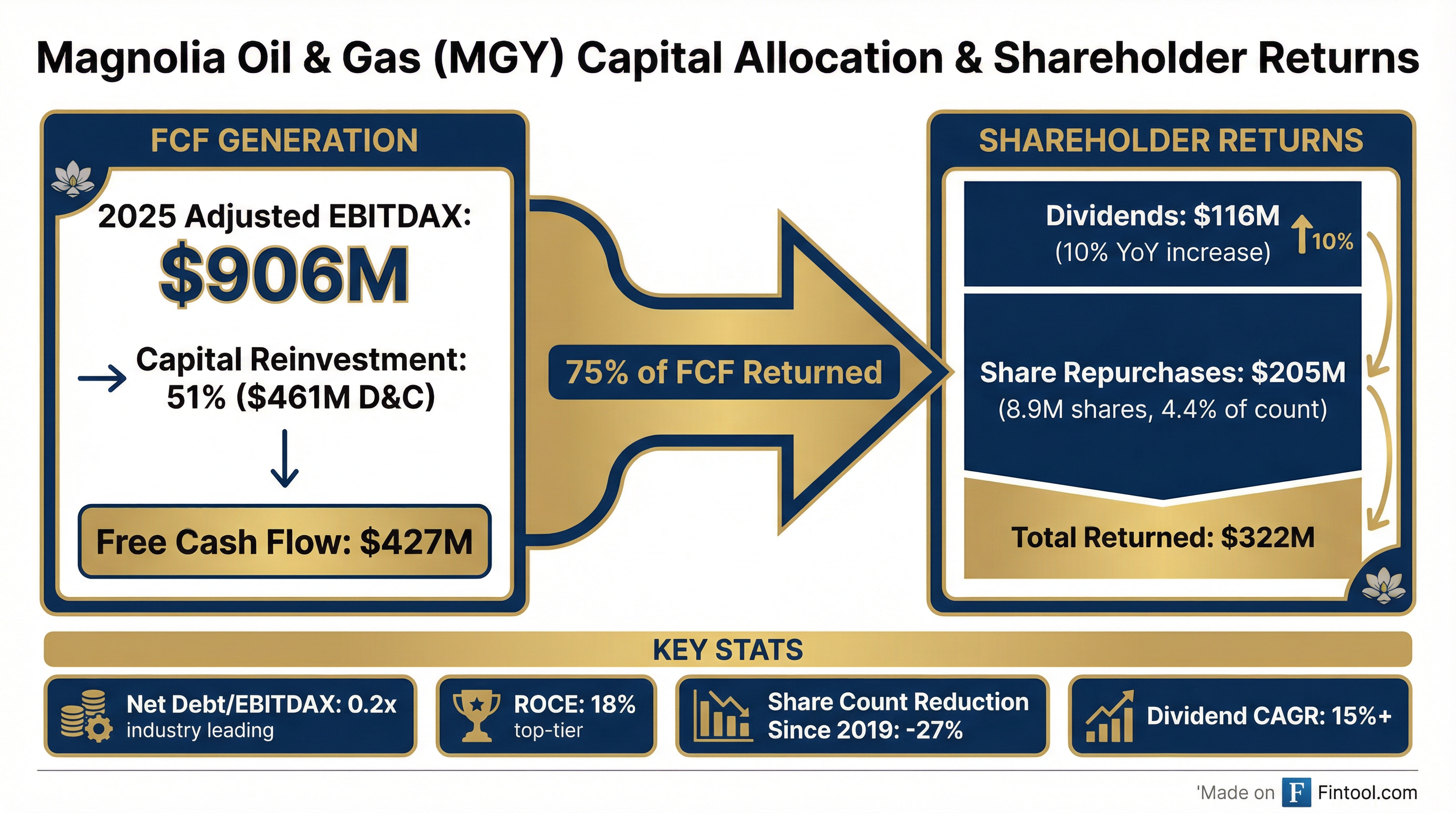
Magnolia's differentiated model centers on returning substantial capital to shareholders while maintaining a fortress balance sheet:
2025 Capital Returns:
- Share Repurchases: $205M (8.9M shares, 4.4% of float)
- Dividends: $116M (10% increase announced)
- Total Return: 75% of free cash flow
- New Authorization: 10 million additional shares approved for open market repurchases
Balance Sheet Strength:
- Net Debt: $133M
- Net Debt/EBITDAX: 0.2x — lowest in the industry
- Liquidity: $717M (cash + undrawn revolver)
- No debt maturities until 2032
Since inception, Magnolia has returned >$1.9 billion to shareholders and reduced its share count by 27%.
Peer-Leading Returns:
- 5-Year Average ROCE: 34% (2025: 18%)
- 5-Year Average Reinvestment Rate: 44% (2nd lowest among peers)
- 5-Year Production Growth Per Share CAGR: 14% (2nd highest among peers)
- 5-Year Average Operating Margin: 48% (2nd highest among peers)
Ask Fintool AI AgentReserves and Finding Costs
Magnolia added 49.8 MMboe of organic proved developed reserves in 2025, providing:
- Reserve Replacement Ratio: 137% of production
- Organic F&D Costs: $9.25/boe
- 3-Year Average F&D: $9.85/boe
Total proved reserves increased 10% to 210.2 MMboe, with 79% proved developed.
ESG Highlights
Magnolia highlighted progress on environmental and community initiatives:
- 21% reduction in gross Scope 1 greenhouse gas intensity since 2020
- 68% reduction in gas flared as a percentage of production since 2020
- 39,000 truckloads of water removed from local roads through new infrastructure
- $304M in royalty/lease payments to Texas residents; $521M to local vendors
Q&A Highlights: What Management Said
The analyst Q&A session revealed several key insights not covered in prepared remarks:
On Well Performance Outperformance
Analyst Neal Dingmann asked what's driving the strong well results. CEO Chris Stavros:
"I can't point to anything specific or very different in terms of the completion design... I think what you're seeing is simply the outcome of drilling into some very good rock. When we take a lot of effort in terms of locating the wells and placing the wells, I think there's a better than decent chance that you'll see more of this."
On Well Costs and Service Pricing
Standard Giddings well costs are trending down:
- Prior benchmark: ~$1,100/foot
- Current cost: ~$1,000/foot for 8,000-8,500 ft wells
- Service costs: Flat to slightly down; locked in through H1 2026
Stavros noted: "Should prices for oil be 60 or below, the OFS market can continue to experience some pricing pressure going through this year."
On M&A Strategy
Asked about large acquisition packages in the market, Stavros was clear about Magnolia's preferences:
"I'm not and never really have been a big proponent of very large PDP-heavy deals, as you're more likely to pay full value for these or even higher... I'd really much prefer to focus on opportunities where we have more undeveloped upside."
Competition for deals has increased, and prices for acreage have climbed.
On Buyback Approach
Stavros explained the tactical vs. programmatic approach:
"The programmatic portion of it is the sort of 1% that we're minimally committed to... The tactical portion is what you saw in the fourth quarter, where we underperformed, whether that was mean reversion or whatever. We have the opportunity to lean in or not as things move along on the stock."
On Capital Discipline in an Oil Rally
Asked what happens if oil rises to $70-75, Stavros was emphatic:
"Another rig doesn't come into the picture. That's not the plan... In a better-than-expected commodity price scenario, we just sit there, take the winnings. It's the advantage of having an unhedged outcome. We capture all the upside to commodity prices that will ultimately feed back to the shareholder."
On Maintenance Capital
Analyst Carlos Escalante asked about the capital needed to hold production flat. Stavros estimated: "$400 million-ish feels about right, maybe a little less."
On Oil Price Outlook
Stavros shared his personal view:
"The sentiment as we got out of 2025 was extremely negative... Personally, I've been more constructive on oil as you go into 2026. Two-thirds to three-quarters of the world's oil supply is in some pretty nasty places. That's not going to end anytime soon."
On 2026 Productivity Risk
Asked if productivity gains are sustainable, Stavros was optimistic:
"I think as I look at the risk this year, frankly, it doesn't even feel as great as it was last year. And last year turned out okay. I think the outcome will be pretty good."
Ask Fintool AI AgentKey Risks and Concerns
-
Commodity Price Exposure: Magnolia remains completely unhedged, providing upside leverage but downside risk. WTI at $59/bbl in Q4 compressed margins.
-
Geographic Concentration: 100% Eagle Ford exposure leaves no diversification.
-
Production Guidance Deceleration: 2026 guide of ~5% growth vs. 11% achieved in 2025 may disappoint growth investors.
-
Winter Storm Impact: Q1 2026 production affected by ~1.5 Mboe/d of downtime, though fully restored.
Forward Catalysts
The Bottom Line
Magnolia delivered a clean quarter with beats across the board and record production, but the muted stock reaction reflects an already stretched valuation following a strong run-up. The company's differentiated model — low reinvestment, high returns, fortress balance sheet — continues to generate predictable free cash flow and shareholder returns. The 10% dividend increase marks the fifth consecutive annual raise, and the 27% cumulative share count reduction demonstrates management's commitment to per-share value creation.
For income-focused E&P investors, MGY remains a best-in-class operator with industry-leading capital discipline. The 0.2x leverage ratio provides significant dry powder for opportunistic bolt-on acquisitions through commodity cycles.
Ask Fintool AI AgentData sources: Company 8-K filing dated February 5, 2026; Q4 2025 Earnings Presentation dated February 5, 2026; Q4 2025 Earnings Call Transcript dated February 6, 2026; S&P Global Capital IQ consensus estimates.